Saturday, March 16, 2019

Hatchlings and Drawings

Hello,

It has been precisely a month since I last posted (I hadn't even noticed, the past thirty-so days have been so busy), and I feel obliged to inform you of the numerous new additions to our family.
 Starting off, we have an Antheraea polyphemus moth that emerged from its cocoon. It's a boy! (You can tell by the "fuzzy" antennae.) As you can see in the above picture, when he came out, his wings needed to be spread, so I put the little flopping bundle of joy on the top of its cage to fully spread his wings. Like a small child, it responded to my kindness by profusely defecating on my hand and desk
--I was just trying to help!
 Here he is after he let his wings expand naturally. However, I noticed that they were not flat enough for my liking, so I decided to kindly help him out. After placing him in the freezer for about a week to keep him limber and fresh, I brought him to school and helped him spread his wings more thoroughly--and more permanently. That's what one gets for defecating on my hand.
 A second baby boy came a few weeks later, and met a similar fate. 

Fate was kinder, however, to the uncountable hordes of praying mantises that squeezed their way out of their ootheca over the past few weeks. I have no idea how many have hatched (I have seven live ones, have released over twenty into the wild because of space constraints, and more than five have died, so probably around thirty so far). There supposedly can be up to four hundred hatchlings per ootheca, so many more might be released into our local ecosystem.
The first to emerge.

Eating off my hand like a good baby! (Pay attention, A. polyphemus.)

Unfortunately, some of them are not able to get out of the egg case before their bodies harden and they become stuck. With their legs glued together, they have no hope of survival, so it would not be by any means immoral to just put them in ethanol. I will not state whether or not I put them in ethanol immediately, as I would prefer not to feel judged.

Sawfly larvae are also hatching, like these Xyela sp. I found rolling about on our trampoline. In addition to making a fine addition to my collection...

 ...they make wonderful snacks for the kiddos. 

I just came back from a vacation to Alabama, where we saw Bellingrath Gardens and found many, many spiders--but upon entering my room, I discovered a terrible sight:
 One of the seven mantises I have room to keep had died. From his position and the fact that he was literally stuck to the floor of his container, I inferred that he had drowned in a small droplet of water and dried out with the water. None of the other babies suffered this fate, fortunately. After scraping him off with a piece of pine straw, I found a replacement among the eighteen mantises that had hatched while I was out of town. The rest of them had to go to the garden, except for the three that had died. Baby mantises have a surprisingly high mortality rate.

On the subject of death, all these fine fellows succumbed to some mold or mildew or bacteria or something like that that was growing in their tank. They had survived the same plague many times before, and one or two of them showed signs of life for a few days, but when they all stopped moving, I had no choice but to dispose of the bodies of some of my best friends. 
Some might be disposed to blame me for their deaths; after all, I allowed the tank to get to fatal levels of toxic growth. However, I had cleaned the tank out three days before, and the water looked perfectly clear from above--it was only after scraping the bottom that I realized what had killed them. It definitely wasn't my fault. No kidding. I'm a good insect parent. 


 On a combined note of death and life, I saw this at our local Science Museum.
The little dust specks under the stag beetle are signs of a carpet-beetle infestation (Anthrenus spp.).
This shed larval exoskeleton is also sing of an infestation.
I heroically informed the Museum curators, who were thankful for my careful observation. Would you believe that they even offered to hold a parade in my honor? You should. I, however, being so very humble, politely declined. 

The reason I was aware of the problem of carpet beetles is because we have found some in our school's collection. We have yet to do anything about it, but we know they're there.

On the subject of damaged insects, the above image depicts a black-form female Tiger Swallowtail (Papilio glaucus) I found on the side of the Natchez Trace. Its left wing was undeveloped and it was cold, with no hope of it expanding naturally, so I picked it up and brought it home. Unfortunately, even though it hung from the ceiling of a jar for more than a day, its wing never expanded. There was no way it could have survived that debilitation --it wouldn't even eat when I placed flowers and mud into its cage (yes, swallowtails eat mud and even manure). Therefore, I put it in the freezer, where it still resides, until I can figure out whether I can still spread it.

On the happy subject of butterflies, I drew a Malachite (Siproeta stelenes) that I saw on a missions trip to El Salvador over the summer. Special thanks to my sister for letting me borrow her markers, but no thanks to her for constantly pestering me to give them back. Art takes time! I've only had them for three weeks now!

However, I got frustrated with another, larger butterfly drawing (on which I have spent five hours and gotten halfway done), and decided to draw a Glyphodes grandisalis I had seen in a photographic atlas of moths. It was fun being able to draw something in less than an hour!

Now, onto everyone's favorite part: the miscellanies.
At Bellingrath, we saw a Rough Greensnake (Opheodrys aestivus) that had been infected by Snake Fungal Disease. SND is a growing problems among snake populations in the States. I think it kills them (as most fungal diseases seem to do).

 My brother also found a tiny Portuguese man of war, which I collected carefully in a vial and placed in ethanol later, where it rapidly changed from purple to clear. Chemistry is weird.

That's basically everything that has happened over the last month. I hope updates will become more frequent as spring approaches and my praying mantises grow!

Saturday, February 16, 2019

Coleopterans, Scales, and Stereoscopes


Greetings,
     We have had some interesting developments as of recently. Not only have my Saturniid cocoons been vibrating rather noisily (indicating that they will soon emerge), but also my mealworm has finished metamorphosing into a full-fledged darkling beetle (more specifically, an adult Zophobas morio)! At first, it was a very light, slightly translucent tan (second picture below), but then it became a very bold maroon, and finally black, when it was completely hardened. I was very surprised that it took so long for its exoskeleton to harden! I don't have any pictures of it after it completely turned black because now it looks pretty boring. If you want to see how it looks, you can google it.


     I also got to find a surprising weevil--surprising in that I was able to get it down to a Species identification: Cyrtepistomus castaneus, the Asian Oak Beetle. (OK, maybe iNaturalist's A.I. suggested it, but let's pretend that I keyed it.)


Here is a closeup of its mandibles, showing the emerald green "throat" that makes it look pretty cool.


      What is really cool about these pictures (and which you might not have noticed due to the relatively poor image clarity) is that every part of the insect is in focus, at a microscopic level. This is not your normal iPhone quality picture. Rather, it is the work of an EPIC stereoscope I have access to through my high school. It has a "z-stacking" function that causes it to take like fifty-gazillion pictures and merge the images. It takes forever, but the end pictures are super cool. Not every microscope can focus on the tarsus and the coxa simultaneously. It can also create 3-D images and be hooked up to a 3-D printer (barring the myriad technical issues that have insofar prevented us from doing so).
     While I was at it with the weevil, I decided to get some detailed pics of some infinitesimal arachnids I found that I don't have time to key. (OK, I just don't want to key them.)

 To perfect my skills, I decided to practice on a not-so-infinitesimal Leiobunum sp. (it had about a 4-5 cm leg span). 

I then took a picture of an Episinis sp. spider that was about 3 yoctometers across (that's 10^-24 meters). Not super great quality. I'll blame it on the technology. After all, there's no way it could be user error. </sarcasm>

While I was looking for spiders in those curled up dead leaves that get stuck on branches and are pretty easy to see this time of year (yeah, those have spiders in them, generally), I found several of these tiny wasps. They were inside little web-nests, which leads me to believe they somehow parasitize the spiders. I just thought that was pretty interesting.  


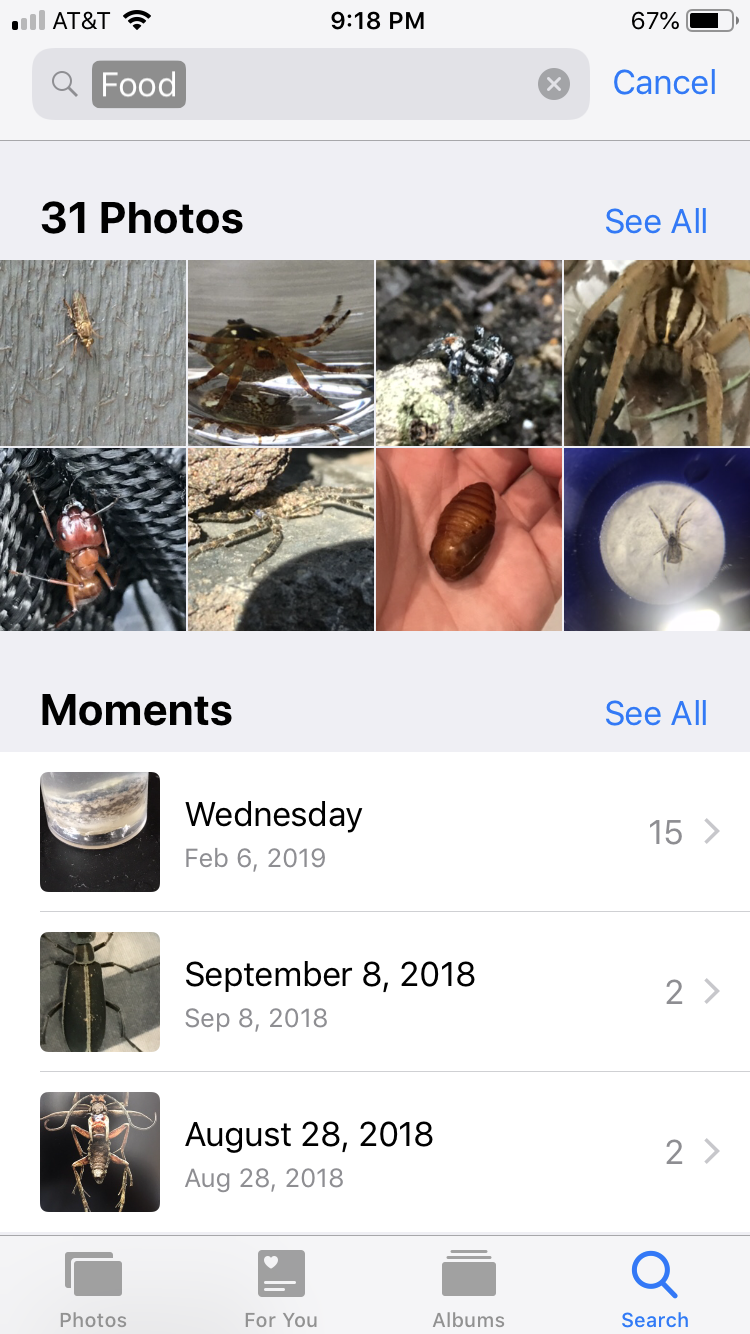
 On the subjects of pictures, arthropods, and prey/food items, I found this rather amusing. Searching for "food" in my iPhone photos revealed nothing but arthropods, mainly spiders. 
 Also, a sizable number of my "reptiles" and "selfies" were, in fact, neither squamates nor Homo sapiens. Apparently, the "smart phone" is unable to distinguish between a dung beetle and my face. 


     Changing the subject, I found a bloodthirsty monster under a brick in our garden. You guessed it! A leech. A nice, pleasant ethanol spa caused it to thrash around in pure glee for a few minutes before fading into a blissful eternity. 
      I never was very fond of leeches.


      On the subject of blood, I found some interesting insects on an unidentified tree: Ceroplastes sp., or wax scales. At first I supposed them to be galls or fungi or something. But I was quite surprised to cut one open to spurts of red bodily fluid!
Looks a tad like a fungus, right?

The hiss of the surgeon’s knife, the gnawing teeth of his saw,
Wheeze, cluck, swash of falling blood, short wild scream, and long, dull,
 tapering groan; 
These so—these irretrievable.
--Walt Whitman, in "Walt Whitman"

I suggest that it was Sargent Grey, with the knife, in the drawing room... 
     On the subject of gross, squashed things, I found one of my old classmates from school, crawling pitifully on the ground, with his entrails spilling out onto the cold tile floor. Being a rather merciful individual, I squashed him and tossed him in the trash.
What? Did you actually think it was a person?


 Apparently, one of the 100 baby cockroaches had escaped.


Saturday, January 26, 2019

The Death of a Good Friend; the Acquisition of a Vinegaroon; Arthropodan Art; New Pets.

December 31, 2018 was a tragic day indeed.


R.I.P. Yoda
     Yoda became very gravid and increasingly weak. I was hoping she would manage to lay her ootheca before death set in, but apparently she decided against it. (She never mated, anyway. I tried to give her one early on, but she just tried to eat him.) We were just about to leave on a family vacation, and I wanted her to be malleable enough to spread properly, so I put her in the freezer. She was in the same position a weak later when I returned, and the cold kept her from decaying before I spread her wings in death.
     You have to give them the proper respect.

     The only light in this gloomy time (other than a family member's marriage, which was remarkably less than gloomy) was the acquisition of a vinegaroon (Mastigoproctus giganteus giganteus). They get their common name from their ability to shoot acetic acid out of a gland on their abdomen. Other notable features are their ginormous pinching/crushing pedipalps (which can make quite a loud cracking noise when striking) and legs that work as feelers like antennae. Gerald III, as my brother promptly named it, is the successor to both my Giant Walking Stick (Megaphasma denticrus) specimens I kept over the summer. I have gotten some good pictures of it, and have videoed its hunting behavior.


Unfortunately, I am currently unable to upload a video on Blogger. I may try to update this post in the future.
This is a Eurymerodesmus sp. I also fed it. They are known for their ability to excrete prussic acid (Hydrogen Cyanide). This apparently was of no consequence to our vinegaroon.


I also have been doing some art in various media. Below is the firefly larvae from last post rendered in colored pencil and graphite.

 Another medium I enjoy (but do not particularly excel at) is Lego. Below is an attempt at an anatomically correct jumping spider. The legs have the correct number of segments, and the eye arrangement screams Salticidae, but the tarantula-like abdomen kinda nullifies the effect. Everyone to whom I have shown it has thought at first it is a tarantula, much to my chagrin. One should always examine the eye arrangement of a spider before pretending to have an accurate identification. This mistake is particularly unforgivable with jumping spiders, whose prominent eyes are impossible to miss. Or maybe I'm just worse with Lego that my bias cares to reveal to me.


Eight eyes, all in the correct position.
     I also acquired a few new pets. I found about seven water striders floating upside-down in our pool and took them in to revive them. I had a 57% success rate (just under my 66% waterlogged honeybee rehabilitation success), and the four that survived are still going strong. I find it particularly interesting how quickly they are willing to attack things their own size, like these crane flies shown in the images below. 


      The last of my mealworms decided to pupate; whenever it becomes a beetle, it shall make a fine addition to my school's collection.


      I have also begun work on a bug book. The provisional title is "Hydroarthropoda." I shall paste my tentative description below:

Hydroarthropoda sits under the uneasy haze of armistice. Few of the eight distinct tribes share any common interests, and history has demonstrated that force is most tribes’ method of choice for settling conflicts. As the factions are inched closer and closer to open conflict by a mysterious rumor, a twenty million strong army of marauders advances from the west. The humorously suave and comically verbose invaders have an ingenious strategy: no survivors equal no one to warn future victims. Follow the witheringly sarcastic Gerris and his high-key extroverted companion Cox as they attempt to unravel the mystery threatening to destroy their world, while unearthing their own unknown biases and shortcomings. When a cold murderer appears on the scene of the confusion with tales of the approaching army, will the duo be able to warn Hydroarthropoda in time to avoid utter destruction?

      I included that simply in an attempt to give myself some sort of accountability. I think the plot is decent, if it is currently being poorly executed, and the experience should be pretty fun. I hope all the good news will keep y'all from going into depression over the tragic death of Yoda. To think: One more day and she would live lived to see her first January!

(Sniffle) Goodbye!


Tuesday, December 4, 2018

Giant Jumping Spider, 48 Baby Cockroaches, and Cool Mantidfly.


Hello!

It's been a minute since I last posted, and a lot has happened. Well, OK, only one thing happened: I got hit by a freight train named "school." Because of that, I'll have to pull a praeteritio and not discuss the discovery of about five Polyphemus moth cocoons, my acquisition of a toad bug, my friendly pet assassin bugs, and much more. So, over the past few months, here are the highlights:

GIANT JUMPING SPIDER

I have always found it odd how negatively people respond to the words "jumping" and "spider" in the same sentence. To me, it screams "I'm cute! Pet me!" This Phidippus otiosus was the largest jumper I had ever seen. At about a centimeter and a half, it is pretty magnificent (and cute).


Here is a slow-mo of it jumping.


"PREHISTORIC" ARTHROPOD

The firefly larvae, colloquially known as the trilobite beetle due to its resemblance to the extinct creatures, is really quite neat. They have tiny, noodle-like heads which they hide in their thorax area and use to get deep inside of the shells of the snails they disembowel for breakfast.

Flexing his muscles.

 GIANT COCKROACHES

Some people are OK with jumping spiders but still possess an irrational fear of cockroaches. However, you must admit that these little fellas are darlings. I got about fifty of them from my science teacher, whose roaches were accidentally purchased gravid. I brought them home, all prepared to become the proud father of forty eight.
Could only get so many of them together.

SO CUTE!


You can see the antennae moving so quickly!

If you notice, the orangish boarder of the cockroach mimics that of the firefly larvae. It makes me wonder what function it serves; both are ground-dwelling critters that hide in leaves. Leave any ideas in the comments!

 Immediately, I took the opportunity to add some variance to Yoda's diet. 
Crunchy on the outside, gooey on the inside.

The legs were twitching when I took the picture.

 COOL MANTIDFLY

I caught an Anasaitis canosa (Twin Flagged Jumping Spider) and it laid eggs and THIS came out. 

Evidence for the hopeful monster theory? (The idea that one day a lizard laid an egg and out hopped a bird.) Not quite. Some mantidfly species are parasites of jumping spiders; this one just happens to be one of them. They such the blood out of the adults until they lay eggs, then they get in the eggs and eat them. Really neat little creatures! The big eyes do add some element of cuteness, but not as much as the cockroaches.
See you next time!