Wednesday, May 15, 2019

A Dead End, Fine Additions, and Macro Photography.

Wow! It is hard to believe that it has been almost two months since my last post.
As might be expected with the advent of spring, I have photographed a lot of cool insects and spiders. However, there's also been a lot of death. So I've decided to take Kurt Vonnegut's approach and follow every death with "so it goes."
I've also begun to investigate a few mysterious behaviors...and reached a dead end. So it goes. Not, however, as dead as this Lytta sp. blister beetle I found half-buried in a wasp nest.
So it goes...or does it?

I am not entirely certain that the wasp I caught was the instigator. She was walking away from the hole approximately seven inches away from the opening, while the blister beetle sat motionless inside. At first, I couldn't tell what kind of beetle it was, so I picked it up. It made no response. Upon recognizing it as a blister beetle, I quickly put it into a vial--they get their name from the irritating substance they secret that can cause blisters and hurt the eye.

The wasp was far too quick and small for me to get a good photo, and I have not had time to look at it under my school's high-tech stereoscope, so these are the best photos I've got. It is either an Ichneumon or a Braconid wasp; I cannot differentiate well enough between the two families to know which it is.


However, the beetle seemed to recover after a few minutes; it walked around for a few days, and I fed it lettuce. Then it died. So it goes. I kept the corpse in a jar in my room to see if a wasp would hatch out, but one never did. So it goes.

In addition to the grotesque mystery of the parasitic wasp, I have observed some other interesting interactions, one between the beautiful groundsel bush beetle larvae, Trirhabda bacharidis and the groundsel bush, Baccharis halimifolia.

The iridescent larvae shimmer red, purple, blue, green, and even gold in the spring sun, while they cheerfully munch away on the groundsel bushes lining the Natchez Trace walking trail I regularly traverse. However, with as many as twelve of the ravenous larvae on each branch, there was little left of most of the groundsel bushes. So it goes. I decided to help the bushes out, add to the school collection, and clean trash from the Trace all in one. I had left my vials at home, so I adroitly located an old, crumpled soda can and began popping the little larvae into the can.

I was not the only one out to protect the bush while grabbing a beetle or two. This anchor stink bug (Stiretrus anchorago) had seized a hapless larvae and was now sucking up its liquefied internal organs with its straw-like mouth. So it goes. I had never seen a stink bug so colorful, and would have loved to have collected it, but, alas, the soda can was missing the flap that closed the drinking hole. It would have been able to climb out with ease. The larvae I collected, contrariwise, had such a large body-size-to-leg-strength ratio that they could not possibly climb out of the smooth can, and soon they were resting peacefully in ethanol.

When I saw this fella, though, I was prepared. Although not as stunningly beautiful as the anchor stink bug, this Aradus robustus flatbug was an awesome find. Although fairly common, very little is known of their life habits--scientists aren't even exactly sure what they eat. 

A few days later, I found a pair of flatbugs (family Aradidae) under a piece of bark. The only way I was able to catch them was to try to scare them into moving; when they were still, they were so well camouflaged I could not locate them. 
Although very little is known about flatbugs, the camouflaging abilities of the family are being researched for their incredible designs. See this paper about how the microscopic structure and chemical composition of certain flatbugs makes them "almost superhydrophilic," allowing them to blend seamlessly with their environment when the whether conditions suddenly change: http://bio.biologists.org/content/biolopen/6/8/1209.full.pdf 

 On the subject of cool insects, look what my Fairy God-Mother got me! A Diapherodes gigantea from Skopje, North Macedonia. This is my first insect to have gotten in the mail, and will make a fine addition to my collection! So it goes. In the few months that I have not had enough time to post, I have also not had enough time to go through the fairly time-intensive process of rehydrating it; hopefully, that will change with the onset of summer!

I got another pretty addition to my collection when this Io moth I found at school emerged from its cocoon. 

Immediately after its wings had straightened, I went to show my parents and put it in the freezer. As I opened the freezer door, my mom called out something to the effect of, "don't hurt the poor thing!" To which I replied, "Don't worry, Mom, it will be fine." And it was! The next day, it was perfectly fine, and let me pin and spread it with no resistance whatsoever. So it goes.

With one fewer pet to care for, I just had to acquire another one. A tan jumping spider (Plattycriptus undatus) was more or less forced upon me when I accidentally maimed it while trying to feed it a cockroach in the wild. With its front legs and pedipalps removed, I knew there was no way it could survive in the wild--so I brought it inside and have been caring for it ever since. 

A closeup of the little fella as he eats a bug I hand-fed to him on the tip of a insect pin.


Speaking of pets, my one surviving mantis is doing great! I released a bunch of the other ones, and some others died of starvation (whoops!) or food poisoning (*cough cough* lawnservice) or cannibalism (OK--so you can't put more than one in the same container). He/she is already in the third instar, and is tackling larger and larger prey every day.

I have been using my macro lens for my iPhone more and more, recently. Not all of them are great (like the one above, where the clip-on part is visible in the photo). However, some of them are pretty good, I think. Here are a few:
Unidentified weevil

Same weevil.

Plecia neartica, lovebugs, mating. 

Echanacia purpurea, purple coneflower, with snail slime.

Toxomerus marginatus, margined hover fly, on Tradescantia ohiensis, bluejacket.

Hydrangea querifolia, Oakleaf Hydrangea, flower.

A few days ago, I gained a new member of my family: a baby praying mantis, freshly hatched outside our back porch. I've been watching the ootheca for months now, and was delighted to see this guy crawling up our screen. Hopefully, I'll be able to catch a few more of these guys over the next few weeks. 
Thanks for reading!

Saturday, March 16, 2019

Hatchlings and Drawings

Hello,

It has been precisely a month since I last posted (I hadn't even noticed, the past thirty-so days have been so busy), and I feel obliged to inform you of the numerous new additions to our family.
 Starting off, we have an Antheraea polyphemus moth that emerged from its cocoon. It's a boy! (You can tell by the "fuzzy" antennae.) As you can see in the above picture, when he came out, his wings needed to be spread, so I put the little flopping bundle of joy on the top of its cage to fully spread his wings. Like a small child, it responded to my kindness by profusely defecating on my hand and desk
--I was just trying to help!
 Here he is after he let his wings expand naturally. However, I noticed that they were not flat enough for my liking, so I decided to kindly help him out. After placing him in the freezer for about a week to keep him limber and fresh, I brought him to school and helped him spread his wings more thoroughly--and more permanently. That's what one gets for defecating on my hand.
 A second baby boy came a few weeks later, and met a similar fate. 

Fate was kinder, however, to the uncountable hordes of praying mantises that squeezed their way out of their ootheca over the past few weeks. I have no idea how many have hatched (I have seven live ones, have released over twenty into the wild because of space constraints, and more than five have died, so probably around thirty so far). There supposedly can be up to four hundred hatchlings per ootheca, so many more might be released into our local ecosystem.
The first to emerge.

Eating off my hand like a good baby! (Pay attention, A. polyphemus.)

Unfortunately, some of them are not able to get out of the egg case before their bodies harden and they become stuck. With their legs glued together, they have no hope of survival, so it would not be by any means immoral to just put them in ethanol. I will not state whether or not I put them in ethanol immediately, as I would prefer not to feel judged.

Sawfly larvae are also hatching, like these Xyela sp. I found rolling about on our trampoline. In addition to making a fine addition to my collection...

 ...they make wonderful snacks for the kiddos. 

I just came back from a vacation to Alabama, where we saw Bellingrath Gardens and found many, many spiders--but upon entering my room, I discovered a terrible sight:
 One of the seven mantises I have room to keep had died. From his position and the fact that he was literally stuck to the floor of his container, I inferred that he had drowned in a small droplet of water and dried out with the water. None of the other babies suffered this fate, fortunately. After scraping him off with a piece of pine straw, I found a replacement among the eighteen mantises that had hatched while I was out of town. The rest of them had to go to the garden, except for the three that had died. Baby mantises have a surprisingly high mortality rate.

On the subject of death, all these fine fellows succumbed to some mold or mildew or bacteria or something like that that was growing in their tank. They had survived the same plague many times before, and one or two of them showed signs of life for a few days, but when they all stopped moving, I had no choice but to dispose of the bodies of some of my best friends. 
Some might be disposed to blame me for their deaths; after all, I allowed the tank to get to fatal levels of toxic growth. However, I had cleaned the tank out three days before, and the water looked perfectly clear from above--it was only after scraping the bottom that I realized what had killed them. It definitely wasn't my fault. No kidding. I'm a good insect parent. 


 On a combined note of death and life, I saw this at our local Science Museum.
The little dust specks under the stag beetle are signs of a carpet-beetle infestation (Anthrenus spp.).
This shed larval exoskeleton is also sing of an infestation.
I heroically informed the Museum curators, who were thankful for my careful observation. Would you believe that they even offered to hold a parade in my honor? You should. I, however, being so very humble, politely declined. 

The reason I was aware of the problem of carpet beetles is because we have found some in our school's collection. We have yet to do anything about it, but we know they're there.

On the subject of damaged insects, the above image depicts a black-form female Tiger Swallowtail (Papilio glaucus) I found on the side of the Natchez Trace. Its left wing was undeveloped and it was cold, with no hope of it expanding naturally, so I picked it up and brought it home. Unfortunately, even though it hung from the ceiling of a jar for more than a day, its wing never expanded. There was no way it could have survived that debilitation --it wouldn't even eat when I placed flowers and mud into its cage (yes, swallowtails eat mud and even manure). Therefore, I put it in the freezer, where it still resides, until I can figure out whether I can still spread it.

On the happy subject of butterflies, I drew a Malachite (Siproeta stelenes) that I saw on a missions trip to El Salvador over the summer. Special thanks to my sister for letting me borrow her markers, but no thanks to her for constantly pestering me to give them back. Art takes time! I've only had them for three weeks now!

However, I got frustrated with another, larger butterfly drawing (on which I have spent five hours and gotten halfway done), and decided to draw a Glyphodes grandisalis I had seen in a photographic atlas of moths. It was fun being able to draw something in less than an hour!

Now, onto everyone's favorite part: the miscellanies.
At Bellingrath, we saw a Rough Greensnake (Opheodrys aestivus) that had been infected by Snake Fungal Disease. SND is a growing problems among snake populations in the States. I think it kills them (as most fungal diseases seem to do).

 My brother also found a tiny Portuguese man of war, which I collected carefully in a vial and placed in ethanol later, where it rapidly changed from purple to clear. Chemistry is weird.

That's basically everything that has happened over the last month. I hope updates will become more frequent as spring approaches and my praying mantises grow!

Saturday, February 16, 2019

Coleopterans, Scales, and Stereoscopes


Greetings,
     We have had some interesting developments as of recently. Not only have my Saturniid cocoons been vibrating rather noisily (indicating that they will soon emerge), but also my mealworm has finished metamorphosing into a full-fledged darkling beetle (more specifically, an adult Zophobas morio)! At first, it was a very light, slightly translucent tan (second picture below), but then it became a very bold maroon, and finally black, when it was completely hardened. I was very surprised that it took so long for its exoskeleton to harden! I don't have any pictures of it after it completely turned black because now it looks pretty boring. If you want to see how it looks, you can google it.


     I also got to find a surprising weevil--surprising in that I was able to get it down to a Species identification: Cyrtepistomus castaneus, the Asian Oak Beetle. (OK, maybe iNaturalist's A.I. suggested it, but let's pretend that I keyed it.)


Here is a closeup of its mandibles, showing the emerald green "throat" that makes it look pretty cool.


      What is really cool about these pictures (and which you might not have noticed due to the relatively poor image clarity) is that every part of the insect is in focus, at a microscopic level. This is not your normal iPhone quality picture. Rather, it is the work of an EPIC stereoscope I have access to through my high school. It has a "z-stacking" function that causes it to take like fifty-gazillion pictures and merge the images. It takes forever, but the end pictures are super cool. Not every microscope can focus on the tarsus and the coxa simultaneously. It can also create 3-D images and be hooked up to a 3-D printer (barring the myriad technical issues that have insofar prevented us from doing so).
     While I was at it with the weevil, I decided to get some detailed pics of some infinitesimal arachnids I found that I don't have time to key. (OK, I just don't want to key them.)

 To perfect my skills, I decided to practice on a not-so-infinitesimal Leiobunum sp. (it had about a 4-5 cm leg span). 

I then took a picture of an Episinis sp. spider that was about 3 yoctometers across (that's 10^-24 meters). Not super great quality. I'll blame it on the technology. After all, there's no way it could be user error. </sarcasm>

While I was looking for spiders in those curled up dead leaves that get stuck on branches and are pretty easy to see this time of year (yeah, those have spiders in them, generally), I found several of these tiny wasps. They were inside little web-nests, which leads me to believe they somehow parasitize the spiders. I just thought that was pretty interesting.  


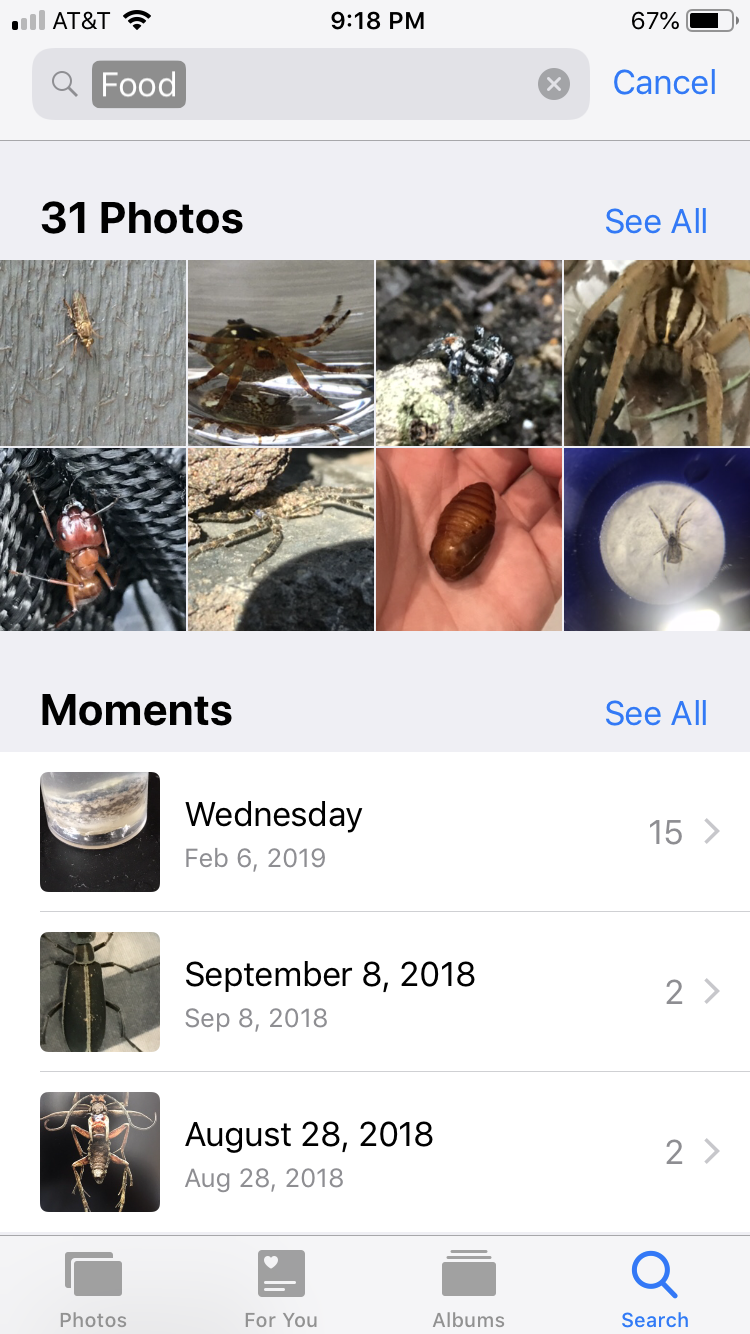
 On the subjects of pictures, arthropods, and prey/food items, I found this rather amusing. Searching for "food" in my iPhone photos revealed nothing but arthropods, mainly spiders. 
 Also, a sizable number of my "reptiles" and "selfies" were, in fact, neither squamates nor Homo sapiens. Apparently, the "smart phone" is unable to distinguish between a dung beetle and my face. 


     Changing the subject, I found a bloodthirsty monster under a brick in our garden. You guessed it! A leech. A nice, pleasant ethanol spa caused it to thrash around in pure glee for a few minutes before fading into a blissful eternity. 
      I never was very fond of leeches.


      On the subject of blood, I found some interesting insects on an unidentified tree: Ceroplastes sp., or wax scales. At first I supposed them to be galls or fungi or something. But I was quite surprised to cut one open to spurts of red bodily fluid!
Looks a tad like a fungus, right?

The hiss of the surgeon’s knife, the gnawing teeth of his saw,
Wheeze, cluck, swash of falling blood, short wild scream, and long, dull,
 tapering groan; 
These so—these irretrievable.
--Walt Whitman, in "Walt Whitman"

I suggest that it was Sargent Grey, with the knife, in the drawing room... 
     On the subject of gross, squashed things, I found one of my old classmates from school, crawling pitifully on the ground, with his entrails spilling out onto the cold tile floor. Being a rather merciful individual, I squashed him and tossed him in the trash.
What? Did you actually think it was a person?


 Apparently, one of the 100 baby cockroaches had escaped.